
SPACE-AIM is a community project created by Genesis Light Foundation. The project entails extracurricular SPACE STEM educational lessons for anyone wanting to learn more about:
Purpose of SPACE-AIM
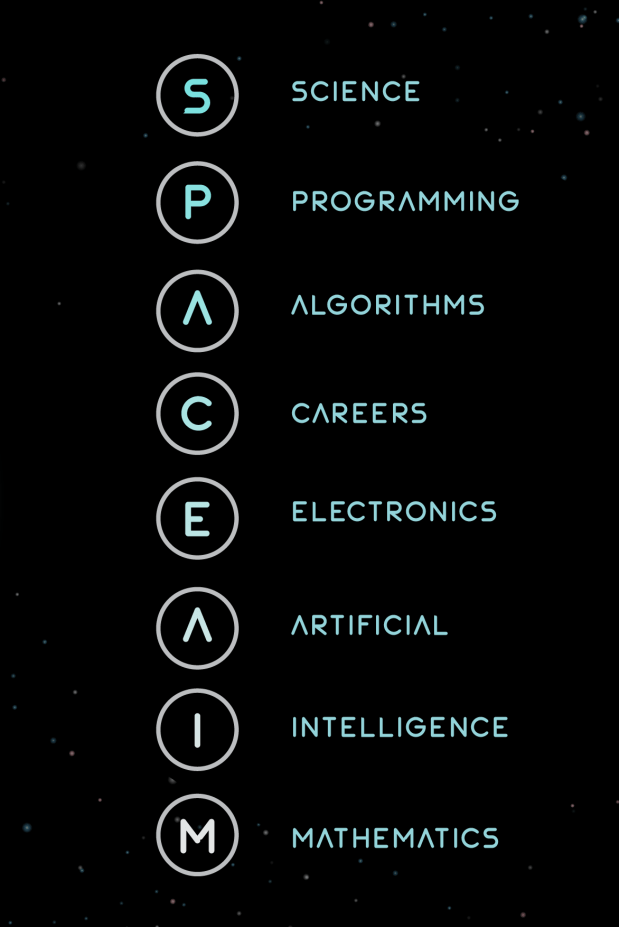
- SCIENCE – Apply scientific knowledge, techniques and logic to solve everyday problems or needs.
- PROGRAMMING – Introduction to programming and using programming as a solution.
- ALGORITHMS – The ability to provide a solution to a question, need, or problem.
- CAREERS – The first three elements, Science, Programming, and Electronics, can be utilised in careers, impacting diverse industries.
- ELECTRONICS – The use of electronics to visually see the effects of using programming and electronics to provide solutions to everyday problems or needs.
- ARTIFICIAL INTELLIGENCE – Use innovative ways to create breakthrough solutions and ideas. Automation can provide assistance in a number of ways.
- MATHEMATICS – Using Mathematical Sciences as the base for all topics covered in this product. Mathematics is a universal language and can be implemented across all areas of interest.
Purpose and Aim:
- To see the possibility of all kinds of solutions in diverse areas of life.
- Make problem solving easy, understandable, and fun.
- To kick-start inspiration and new ideas (innovative concepts).
- Space sciences has gained a lot of interest, so to introduce new ways of thinking along the lines of the future industries, career opportunities, and the future economy.
Who Would Benefit from This?
- Young and old.
- Individuals who want to learn mathematics and science in a fun way.
- Individuals who want to learn more about programming and the basics of electronics.
- Learn about data and visualization.
- Learn how the mathematical world is merged into everyday solutions and activity.
- Discover where mathematics is used over all kinds of industries.
Our lessons utilize a variety of products. Arduino Tool Kits are one of the products we use to assist in the learning of electronics and programming. The lessons introduce the learning of Python coding. Part of our practical lessons incorporate the use of a handy online tool Autodesk® Tinkercad® – to build online electronic models for electronic projects. .

 GenesisLightFoundation